
The best time to visit Georgia is late May to late June and mid-September to late October, the window Georgians call velvet season. Tbilisi sits at 69 to 78 °F (21 to 26 °C) in those months, the Black Sea at Batumi is warm enough to swim from June, and the Kakheti grape harvest opens in September. Skip July and August in the lowlands, when Tbilisi averages 84 to 85 °F (29 °C), and skip February unless you are skiing. This is the country in the South Caucasus, not the US state. Everything below is month by month. Start with our Georgia hotel guide.
The short answer
- Best overall: late May to late June, and mid-September to late October.
- Hottest month: August in Tbilisi, average high 85 °F (29 °C). Coldest: January, 41 °F (5 °C) by day and 25 °F (-4 °C) at night.
- Black Sea swimming: June to October. The sea off Batumi reaches 74 °F (23 °C) in June and peaks at 81 °F (27 °C) in August.
- Wettest place by far: Batumi, at 92 in (2,346 mm) a year over 192 rain days, against 27 in (693 mm) in Tbilisi.
- Ski season: Gudauri's published window for 2026/27 is December 19 to April 18, with the best cover from late January to mid-March.
- Rtveli, the grape harvest, opened in Kakheti on September 10 in 2026 and runs into October.
- Busiest quarter: July to September. The Georgian National Tourism Administration counted 2,956,014 international traveler trips in Q3 2025 against 1,314,828 in Q1.
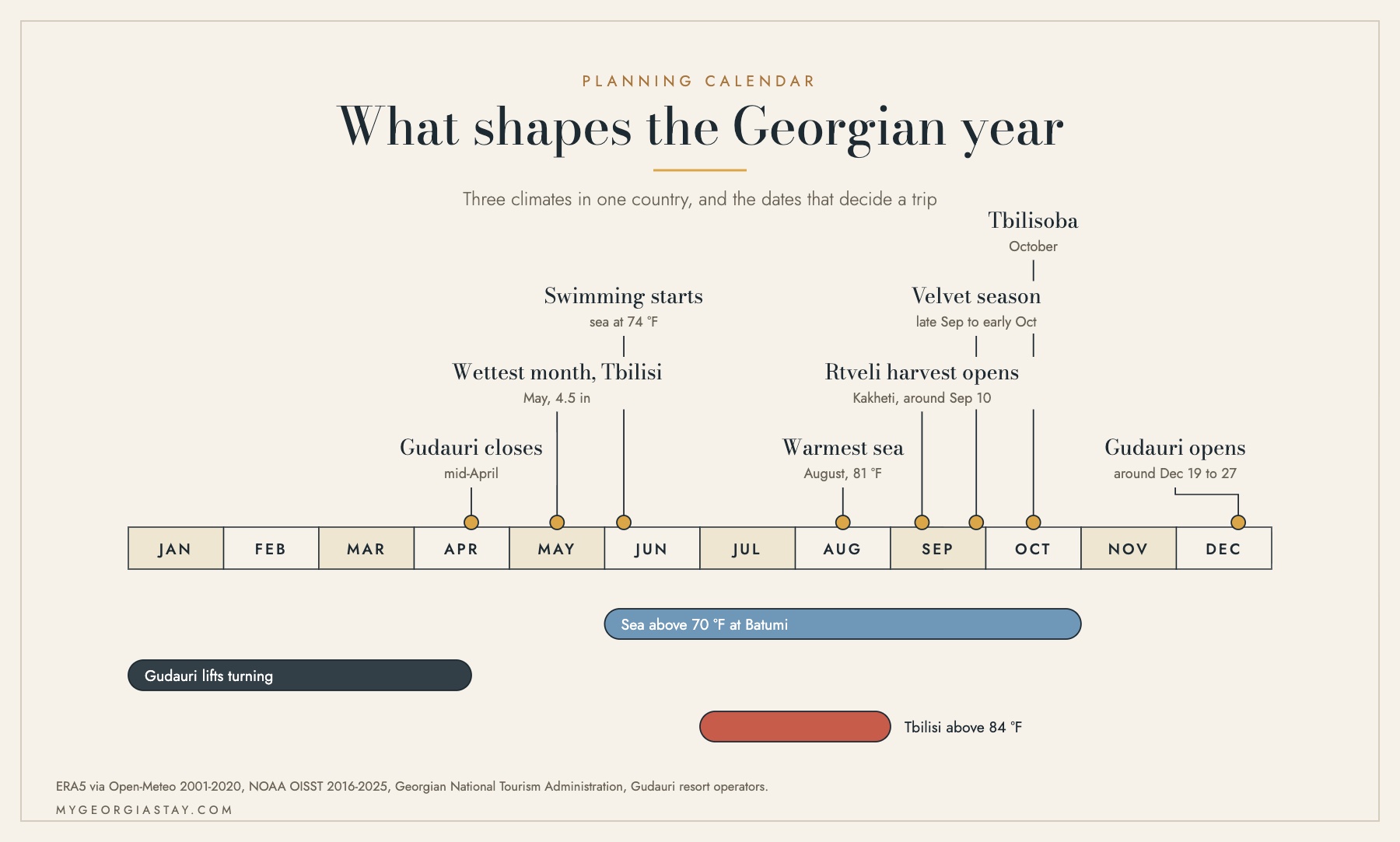
The Georgian planning calendar: three climates, one country, and the dates that decide a trip.
Understanding the climate in Georgia
Georgia is small, about the size of West Virginia, and holds three climates that share almost nothing. Tbilisi, in the interior at about 1,500 feet (460 m), has hot dry summers and cold dry winters. Batumi, on the Black Sea in Adjara, is humid subtropical and one of the wettest places in Europe. Gudauri, on the Georgian Military Highway at about 7,200 feet (2,200 m), is alpine and under snow for five months. Picking a month means picking which of the three you are going for.
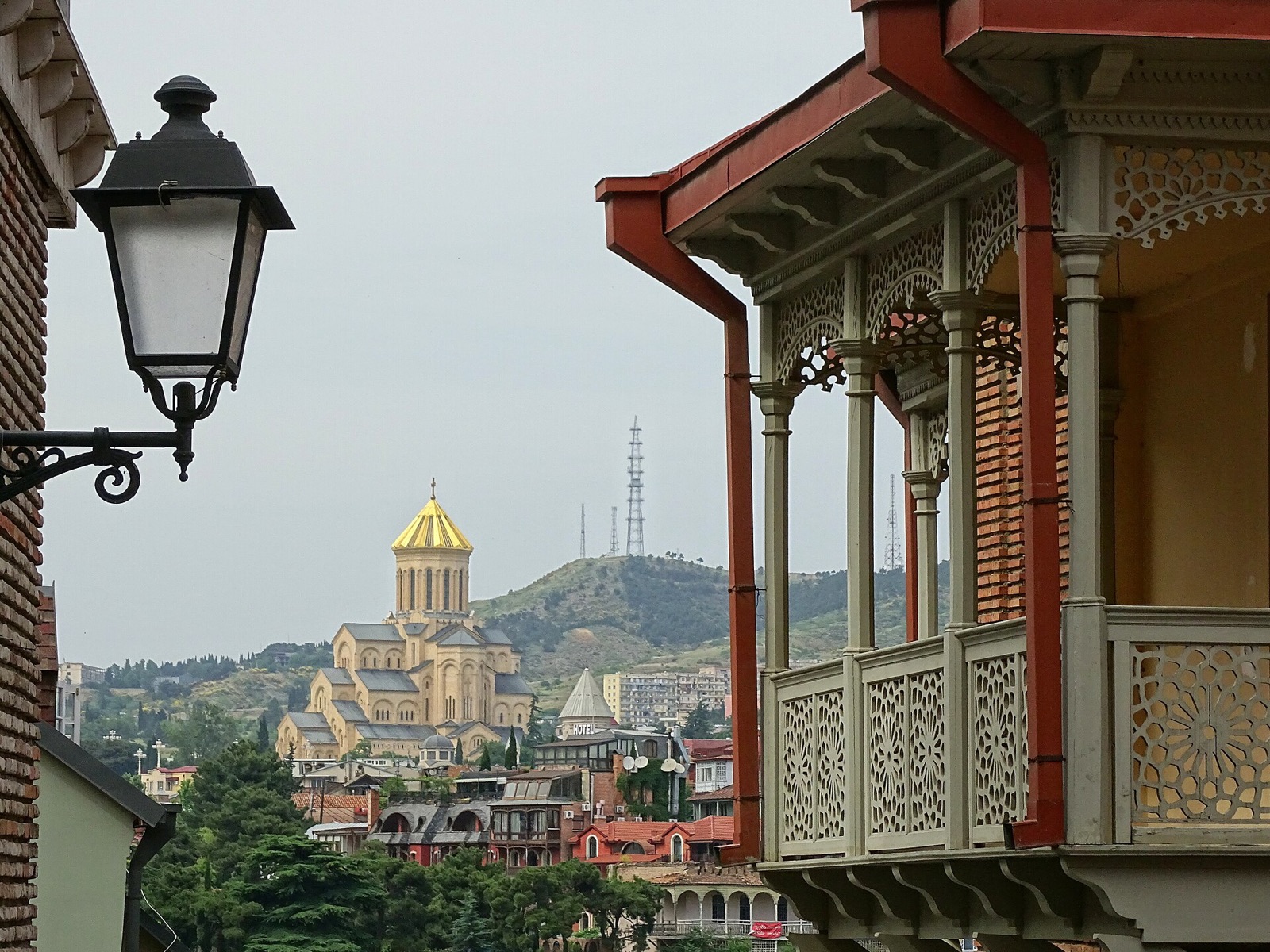
Old Tbilisi. The capital sits at about 1,500 ft in the interior, with hot dry summers and cold dry winters. Photo : Adam Jones, Wikimedia Commons, CC BY-SA 2.0.

| Tbilisi, interior | Batumi, coast | Gudauri, 7,200 ft | |
|---|---|---|---|
| July average high | 84 °F / 29 °C | 78 °F / 25 °C | 64 °F / 18 °C |
| January average high | 41 °F / 5 °C | 48 °F / 9 °C | 23 °F / -5 °C |
| January average low | 25 °F / -4 °C | 35 °F / 2 °C | 8 °F / -13 °C |
| Rain a year | 27 in / 693 mm | 92 in / 2,346 mm | 40 in / 1,009 mm |
| Rain days a year | 110 | 192 | 158 |
| Wettest month | May, 4.5 in | August, 10.9 in | May, 5.2 in |
All three from the ERA5 reanalysis (ECMWF) via Open-Meteo, monthly means 2001 to 2020, counting a rain day as any day with 1 mm (0.04 in) or more. The same definition applies to all three, so the columns are comparable.
The number that reorganizes a trip is Batumi's. The Adjara coast takes three and a half times as much rain as the capital, and its wettest month is August, at 10.9 in (277 mm) across 22 rain days. That is also the month the sea is warmest. Batumi in August is a beach holiday with a thunderstorm in it, not a Mediterranean one.
The Black Sea, month by month
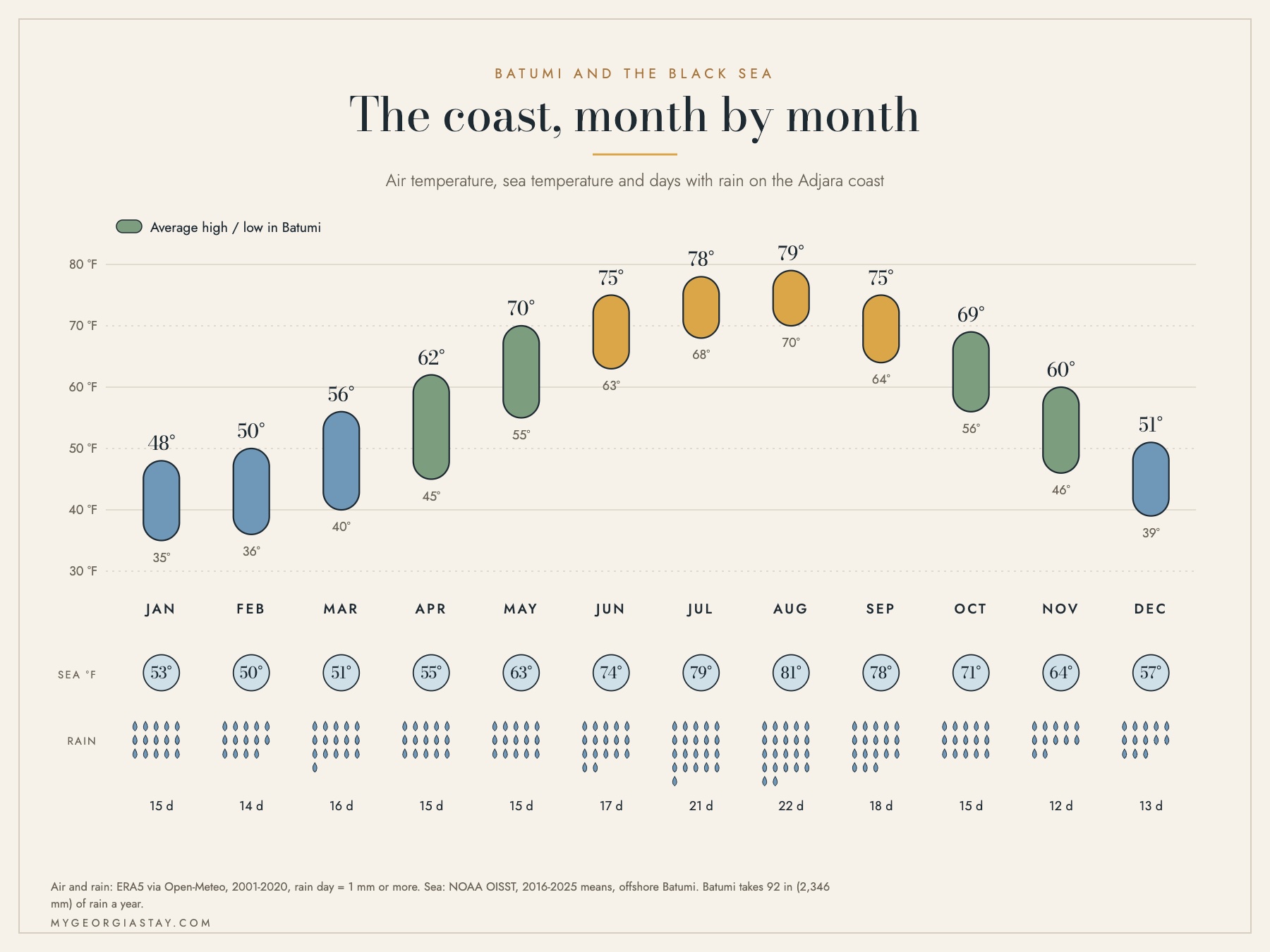
Batumi and the Black Sea, month by month. The sea is warmest in August, which is also the wettest month of the year on this coast.
The sea off Batumi crosses 70 °F (21 °C) in June and stays above it into October, peaking at 81 °F (27 °C) in August on the NOAA OISST satellite record for 2016 to 2025. The air is milder than the interior in both directions: Batumi's January average high of 48 °F (9 °C) is seven degrees above Tbilisi's, and its July high of 78 °F (25 °C) is six below. What you trade for that is rain, in every month of the year.
Spring in Georgia, March to May

Tbilisi's old town and the sulfur baths of Abanotubani. The city walks best from mid-April to mid-June. Illustration : Luxury & Premium Hotel Booking in Georgia.
Spring arrives quickly and wet. Tbilisi climbs from an average high of 52 °F (11 °C) in March to 60 °F (16 °C) in April and 69 °F (21 °C) in May, and the nights stop freezing at the end of March. But this is the rainy half of the interior year: April brings 4.2 in (106 mm) over 14.6 rain days, and May is the wettest month of the Tbilisi year at 4.5 in (115 mm) over 15.7 days.
What spring is good for:
- The cities, from mid-April. Tbilisi and Kutaisi are at their most comfortable for walking before the heat, and the crowd has not arrived.
- Late May in particular. The rain starts to ease, the valleys are green, and the Kakheti vineyards are in full leaf. See our page on the window between rain and heat in Tbilisi.
- Skiing until mid-April. Gudauri usually runs to around April 18, and spring snow at 7,200 feet is warm and forgiving.
What it is not good for: the high mountains. Svaneti, Tusheti and the Kazbegi side roads stay closed or difficult into June, and March in particular is a month of mud and cloud. Our guide to what March weather means for a stay works through the trade.
Summer in Georgia, June to August
Summer splits the country in two. In Tbilisi, July averages 84 °F (29 °C) and August 85 °F (29 °C), with nights at 64 to 65 °F (18 °C). It is dry heat in a river basin, and the middle of the day is not for sightseeing. On the coast and in the mountains, the same weeks are the best of the year.
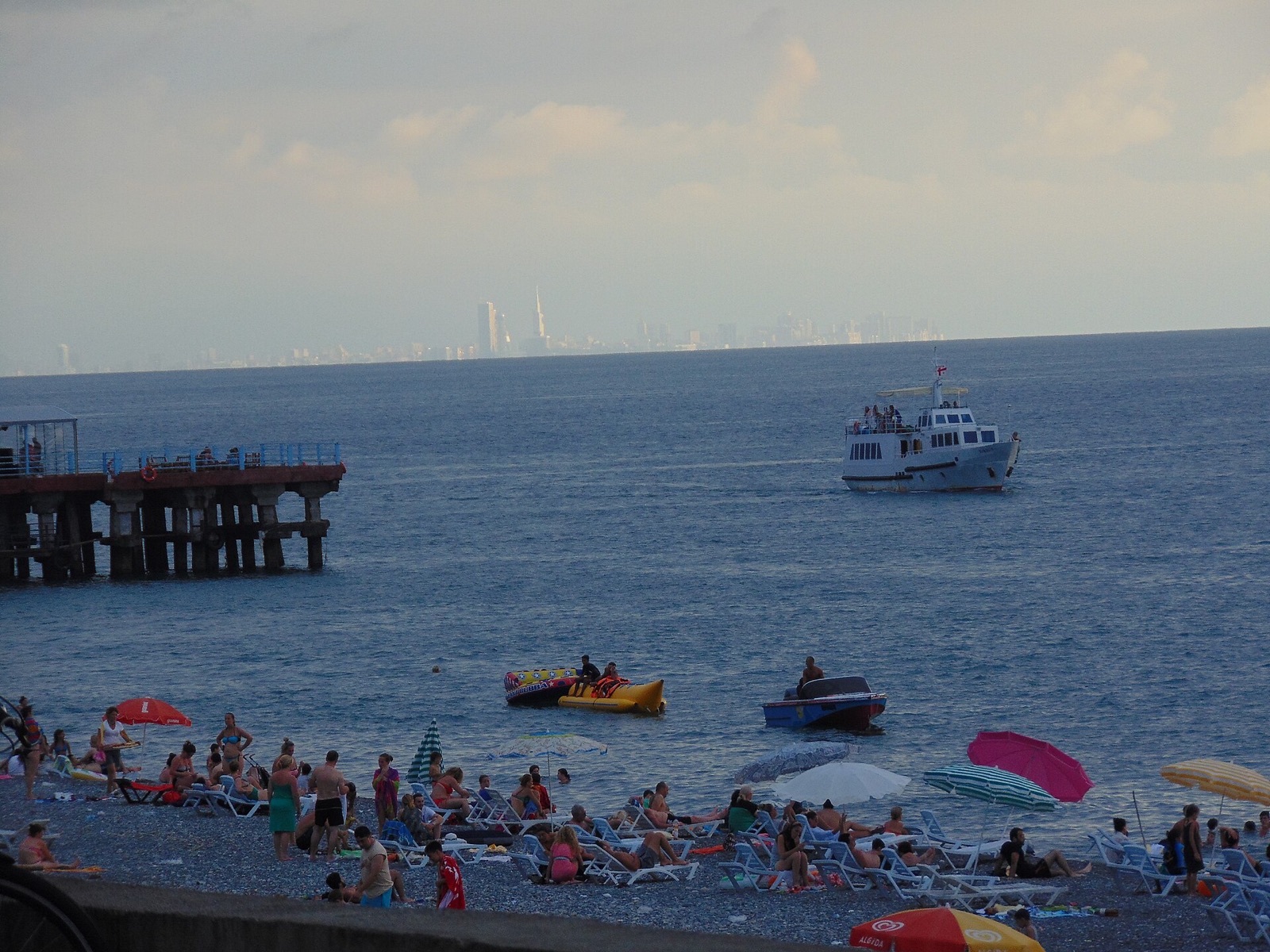
The Adjara coast in August, with Batumi on the horizon. The sea peaks at 81 °F (27 °C) that month. Photo : Kober, Wikimedia Commons, CC BY-SA 4.0.

Batumi is where the country goes. June opens the swimming season with a sea at 74 °F (23 °C) and an air high of 75 °F (24 °C); by August the sea is 81 °F (27 °C). Rooms are at their tightest from mid-July, and our candid guide to Batumi in July and peak season playbook both argue for booking before the rush. Bring the rain into the plan: June, July and August each carry 17 to 22 rain days on the coast.
The mountains are the summer answer
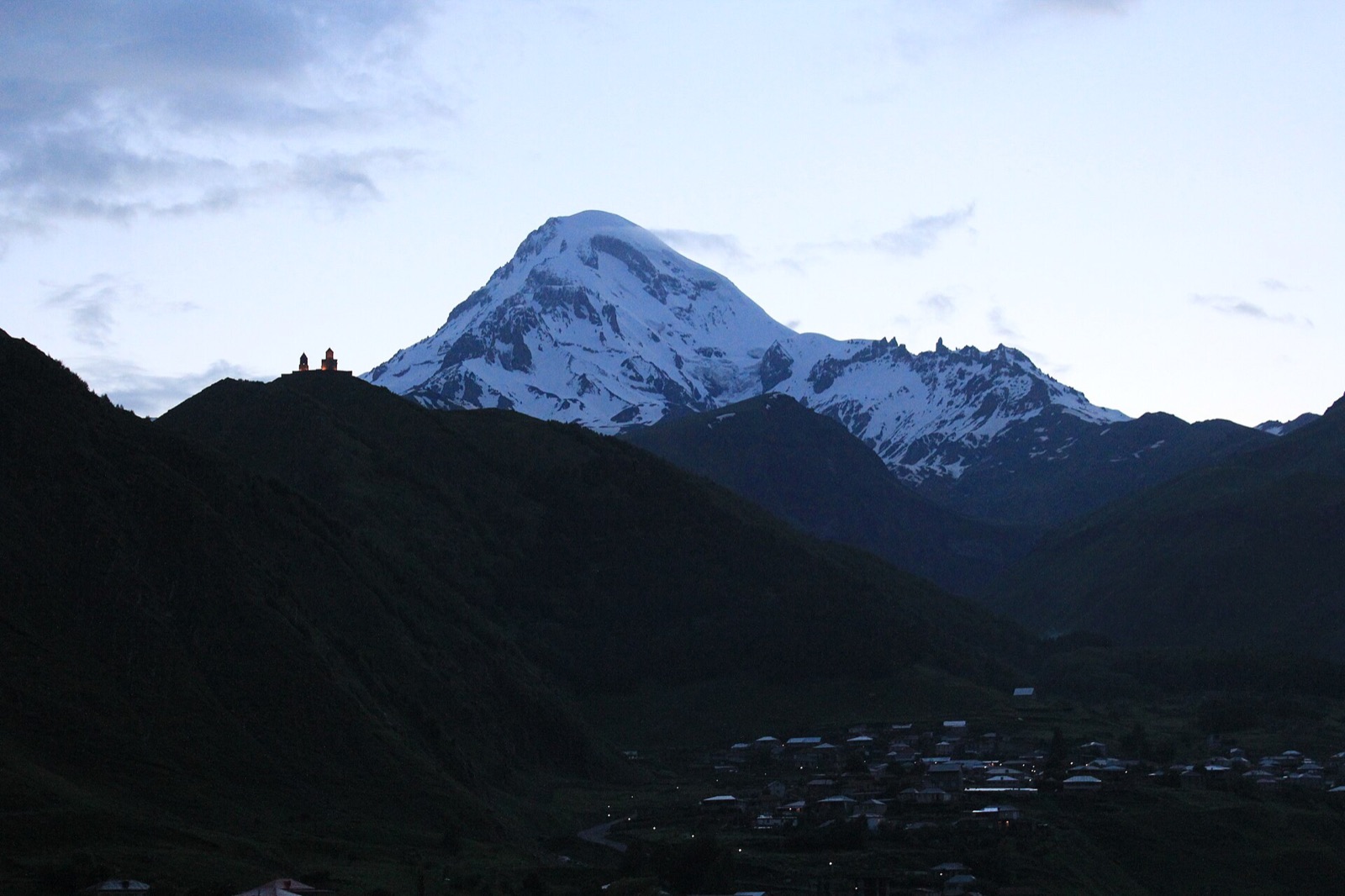
Gergeti Trinity Church above Stepantsminda, with Mount Kazbek behind. July and August are the reliable months for the high roads. Photo : Arian Zwegers, Wikimedia Commons, CC BY 2.0.

At altitude the numbers invert. Gudauri averages 64 °F (18 °C) in July and 65 °F (18 °C) in August, with nights at 49 °F (9 °C). That is the temperature Tbilisi has in early April. July and August are the only reliable months for the high country: Kazbegi and the Gergeti Trinity Church above Stepantsminda, the Svaneti towers at Mestia and Ushguli, and the Tusheti road over the Abano Pass, which is only open in summer. See staying near the Caucasus at Kazbegi, Ushguli and Tusheti.
The spa towns work in the same window. Borjomi and Tskaltubo, both inland and wooded, are at their best in early summer, which our page on Georgia's spa towns in early summer sets out.
Autumn in Georgia, September to November
This is the season locals defend, and the numbers support them. September in Tbilisi averages 75 °F (24 °C) by day and 57 °F (14 °C) at night, with only 2.0 in (51 mm) of rain over 8.1 days. October settles to 64 °F (18 °C). The Black Sea is still 78 °F (26 °C) in September and 71 °F (22 °C) in October, so the beach season outlasts the crowd by a month.
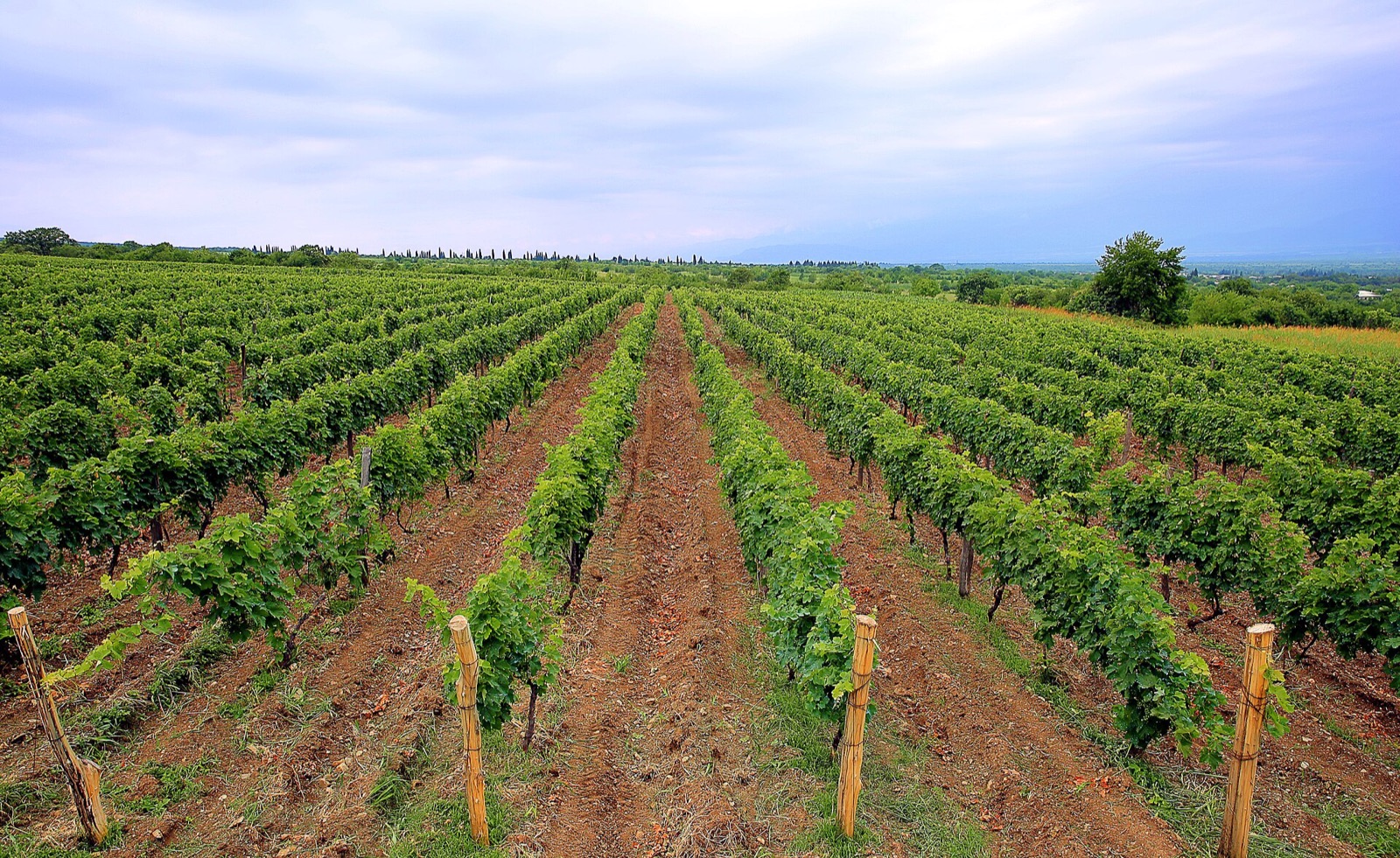
Vineyards in Kakheti, the main wine region. Rtveli, the harvest, opened here on September 10 in 2026. Photo : Chateau Zegaani, Wikimedia Commons, CC BY-SA 2.0.

And the harvest runs. Rtveli is the Georgian grape harvest, and in 2026 it opened officially in Kakheti on September 10. The Georgian National Tourism Administration describes it as beginning with the Rkatsiteli harvest in Kakheti in September and ending in December with Chkhaveri in Guria and Adjara. Telavi, Sighnaghi, Kvareli and Kisiskhevi are the bases. Our page on the pre-Rtveli months makes the case for arriving just before it, and September in Georgia for arriving during it.

A qvevri cellar. UNESCO inscribed Georgian qvevri winemaking on its intangible heritage list in 2013. Illustration : Luxury & Premium Hotel Booking in Georgia.
Georgian wine is made in qvevri, the buried clay vessels that gave the method its name; UNESCO inscribed qvevri winemaking on its Representative List of the Intangible Cultural Heritage of Humanity in 2013. A cellar visit in Kakheti in late September puts you in the middle of the working year rather than a tasting room.
November is the hinge. Tbilisi drops to 52 °F (11 °C), the mountain roads start to close, and the ski resorts have not opened. It is the cheapest month of the year for a reason.
Winter in Georgia, December to February
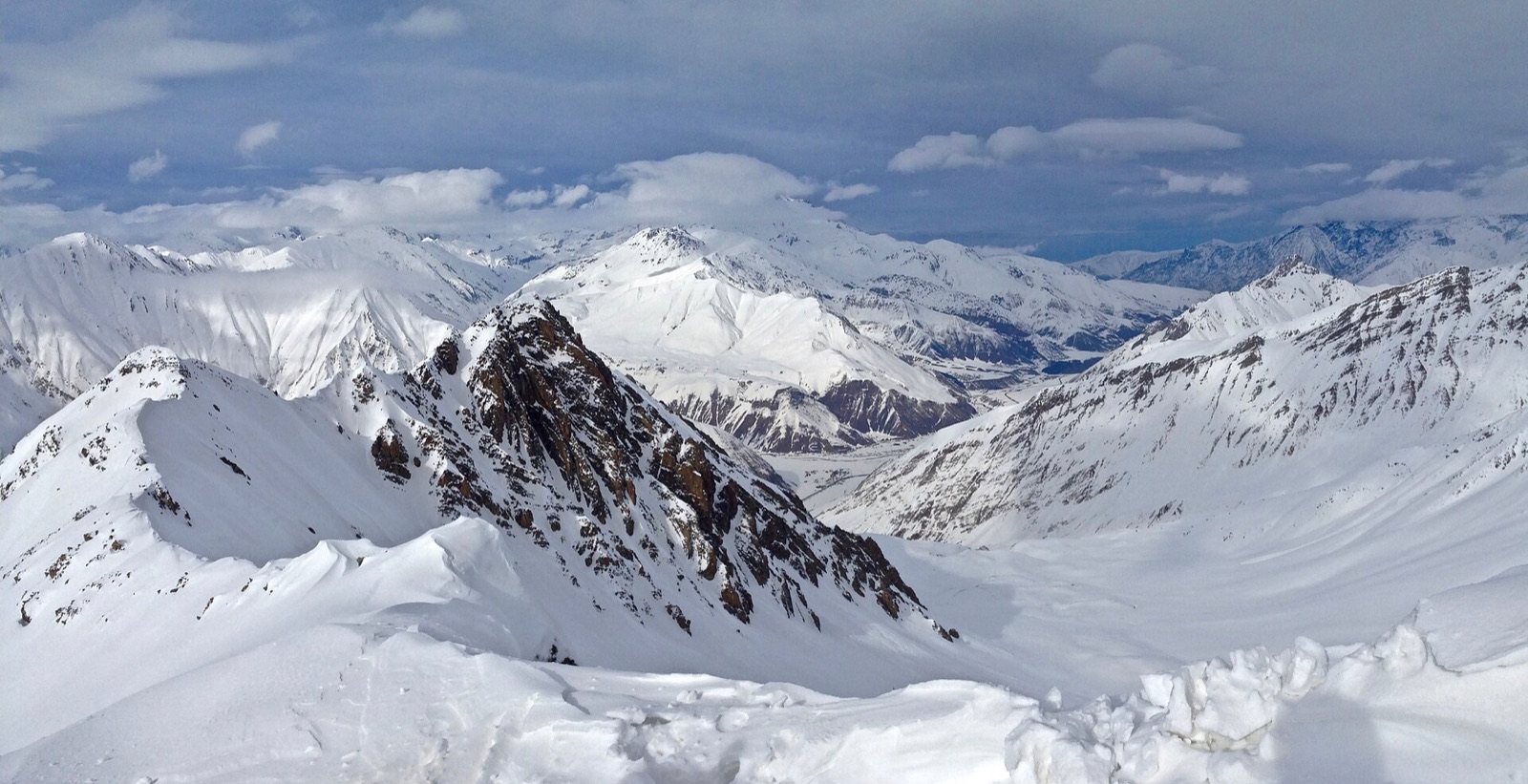
Gudauri, on the Georgian Military Highway at about 7,200 ft. The 2026/27 window runs December 19 to April 18. Photo : Alexey Okhrimenko, Wikimedia Commons, CC0.

Tbilisi in winter is cold and dry rather than harsh. January averages 41 °F (5 °C) by day and 25 °F (-4 °C) at night, with only 1.1 in (27 mm) of precipitation over 6.2 days, the driest stretch of the year. The sulfur baths in Abanotubani, the long lunches and the wine cellars are all winter propositions, and the city is empty of visitors.
The mountains are the reason to come. Gudauri, two hours from Tbilisi up the Georgian Military Highway, is the country's main resort. Its published window for 2026/27 runs December 19, 2026 to April 18, 2027, and in recent seasons the Georgian resorts have opened between December 20 and 27 depending on snowpack, with Bakuriani's Kokhta area usually first. Best cover comes from late January to mid-March.
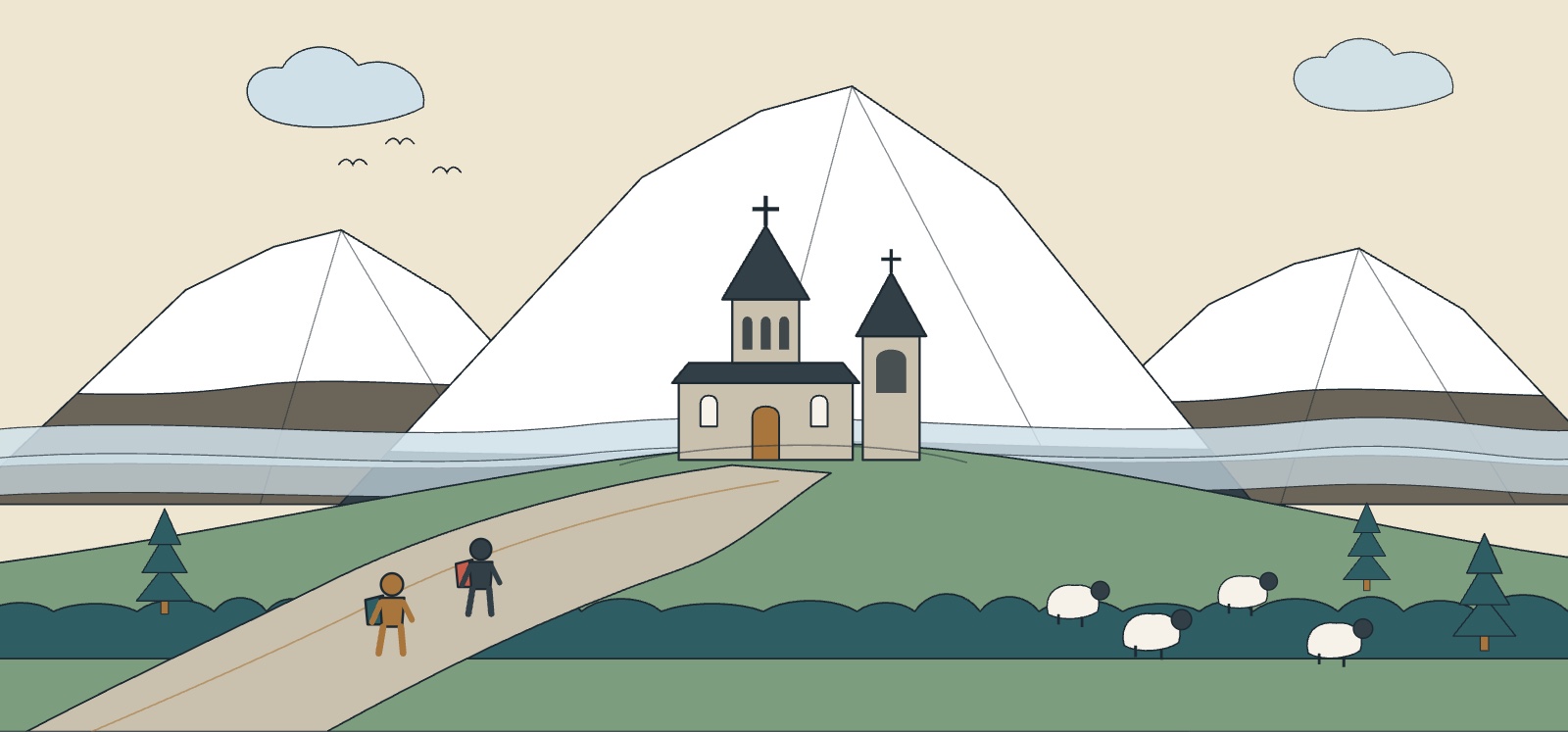
The Kazbegi road, beyond Gudauri. It is the snow that draws people in winter, and the road that stops them. Illustration : Luxury & Premium Hotel Booking in Georgia.
- Gudauri for the terrain and the off-piste, at 7,200 feet on the Military Highway. See our Gudauri hotels.
- Bakuriani in Samtskhe-Javakheti for families and gentler slopes; it hosted the FIS Freestyle and Snowboarding World Championships in 2023.
- Goderdzi in Adjara and Hatsvali above Mestia for deep snow and almost no queue.
- Roads are the constraint, not the snow. The Jvari Pass above Gudauri closes in storms, and the Kazbegi road beyond it can shut for a day at a time.
Our overview of Georgian ski resorts compares them property by property.
Georgia month by month
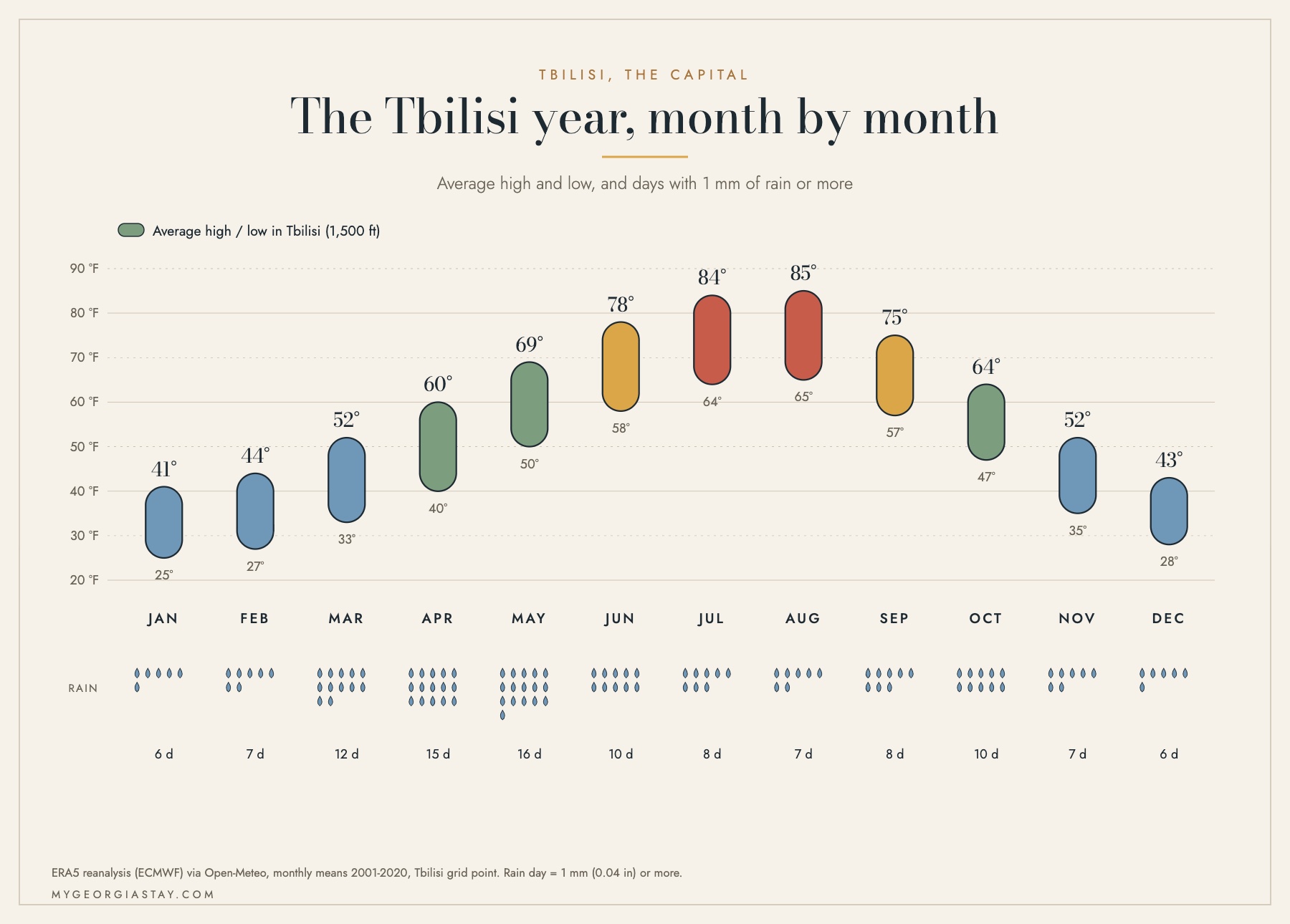
Tbilisi month by month. May is the wettest month in the capital, December and January the driest.
| Month | Tbilisi high | Tbilisi low | Black Sea | Rain, Tbilisi | Rain days | Verdict |
|---|---|---|---|---|---|---|
| January | 41 °F / 5 °C | 25 °F / -4 °C | 53 °F / 11 °C | 1.1 in / 27 mm | 6.2 | Ski, baths, empty city |
| February | 44 °F / 7 °C | 27 °F / -3 °C | 50 °F / 10 °C | 1.2 in / 31 mm | 6.9 | Best snow, little else |
| March | 52 °F / 11 °C | 33 °F / 1 °C | 51 °F / 10 °C | 2.4 in / 62 mm | 11.6 | Mud, cloud, spring skiing |
| April | 60 °F / 15 °C | 40 °F / 5 °C | 55 °F / 13 °C | 4.2 in / 106 mm | 14.6 | Green, wet, cities good |
| May | 69 °F / 21 °C | 50 °F / 10 °C | 63 °F / 17 °C | 4.5 in / 115 mm | 15.7 | Wettest, then excellent |
| June | 78 °F / 26 °C | 58 °F / 15 °C | 74 °F / 23 °C | 2.9 in / 73 mm | 10.1 | Swimming opens, mountains clear |
| July | 84 °F / 29 °C | 64 °F / 18 °C | 79 °F / 26 °C | 1.9 in / 47 mm | 7.8 | Coast and peaks only |
| August | 85 °F / 29 °C | 65 °F / 18 °C | 81 °F / 27 °C | 1.7 in / 44 mm | 6.7 | Hottest, busiest, wettest coast |
| September | 75 °F / 24 °C | 57 °F / 14 °C | 78 °F / 25 °C | 2.0 in / 51 mm | 8.1 | The best month, harvest opens |
| October | 64 °F / 18 °C | 47 °F / 8 °C | 71 °F / 22 °C | 2.7 in / 69 mm | 9.8 | Velvet season, wine, colour |
| November | 52 °F / 11 °C | 35 °F / 2 °C | 64 °F / 18 °C | 1.7 in / 42 mm | 6.7 | Cheapest, roads closing |
| December | 43 °F / 6 °C | 28 °F / -3 °C | 57 °F / 14 °C | 1.0 in / 26 mm | 5.6 | Driest, lifts open late month |
Sources: Tbilisi air temperature, rainfall and rain days from the ERA5 reanalysis (ECMWF) via Open-Meteo, monthly means 2001 to 2020, counting any day with 1 mm (0.04 in) or more. Black Sea temperature from NOAA OISST, 2016 to 2025 means, at a point offshore of Batumi. The rain column is Tbilisi's alone: Batumi takes three and a half times as much, and its month by month figures are in the coast chart above.
The best time for what you want to do
- Tbilisi and the cities. Late April to mid-June, then mid-September to late October. Avoid July and August, when the average high sits at 84 to 85 °F (29 °C).
- Swimming on the Black Sea. Late June to early October. The sea is above 70 °F (21 °C) for those five months and warmest in August at 81 °F (27 °C). September gives you the same water with fewer people.
- Wine and Rtveli in Kakheti. September and October. The 2026 harvest opened on September 10; the work runs into October and, for late varieties, to December.
- The high Caucasus: Svaneti, Tusheti, Kazbegi. July to mid-September. The Abano Pass into Tusheti is a summer road only, and Gudauri averages just 64 °F (18 °C) in July.
- Skiing. Late January to mid-March for cover, with the 2026/27 window running December 19 to April 18 at Gudauri.
- Spa towns, Borjomi and Tskaltubo. Late May to June, and September.
- Value. November and February. Both are genuinely cheap, and neither is a good all-round month: November has closing roads and no lifts, February has the snow and little else.
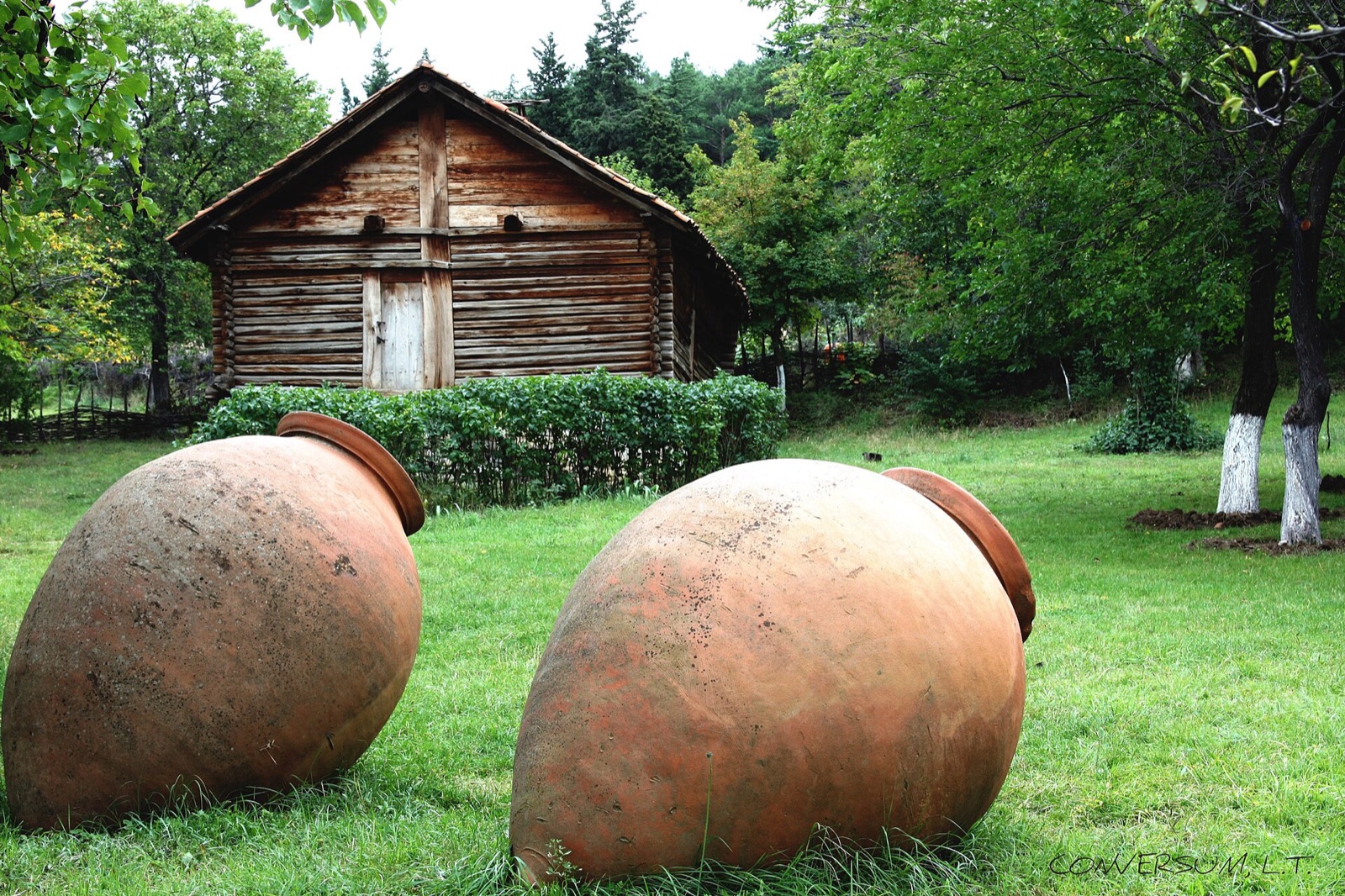
Qvevri, the buried clay vessels Georgian wine is made in. A Kakheti cellar visit in late September lands in the working year. Photo : Levan Totosashvili, Wikimedia Commons, CC BY-SA 2.0.

Events that shape the year
- Ski season opening, late December. Bakuriani's Kokhta area has opened first in recent years, with Gudauri, Mestia and Goderdzi following about a week later.
- Orthodox Christmas, January 7, a public holiday, with the Alilo procession through Tbilisi.
- Rtveli, from around September 10 in Kakheti and running into October, with late varieties harvested in Guria and Adjara as far as December.
- Tbilisoba, October, the capital's city festival, with food and wine stalls through the old town and the Mtkvari embankments.
- Velvet season, late September into early October, the local name for the stretch when the weather is best and the summer crowd has gone.
On volume: the Georgian National Tourism Administration recorded 5,521,866 international tourist arrivals in 2025, up 8.4 percent on 2024. The seasonality is stark. Q3 of 2025, July to September, brought 2,956,014 international traveler trips; Q1, January to March, brought 1,314,828. Summer carries more than twice the winter traffic.
Where to stay
Georgia rewards moving around, and each region has its own season. Five properties from our selection, one per part of the country:
- Vinotel Boutique Hotel, Elene Akhvlediani ascent 4, Old Tbilisi. Thirteen rooms in an 1880s house with carved balconies above brick wine cellars. A city base that works in every month, and best in the winter when Tbilisi is empty.
- Capo Verde Hotel Batumi, Baghi Street 18, Mtsvane Kontskhi. Thirty-eight rooms in the subtropical belt four miles north of the city, next to the Botanical Garden with the sea two minutes below. For the June to September swimming window.
- Chateau White Flags, Kisiskhevi, Telavi municipality. Nine rooms on an 1887 estate above the Alazani valley that still makes wine in its buried qvevri. The September and October address.
- Mountain House Kazbegi, Stepantsminda. Twenty-seven rooms facing Mount Kazbek and the Gergeti Trinity Church. Summer, when the high roads are open.
- Ati Ambavi Hotel Gudauri, Gudauri Hotel Lane. A small house above the tree line on the Military Highway, close enough for ski access. December to April.
The regional directories are the quickest way to compare: Tbilisi, Batumi, Kakheti and Gudauri.
FAQ
What is the best month to visit the country of Georgia?
September. Tbilisi averages 75 °F (24 °C) by day with only 2.0 in (51 mm) of rain, the Black Sea is still 78 °F (25 °C), the high Caucasus roads are open, and the Rtveli grape harvest opens in Kakheti around September 10. Late May and early June are the spring equivalent, with greener valleys and more rain.
Which month is the cheapest to visit Georgia?
November, followed by February. November falls between the end of the autumn season and the opening of the ski resorts, so mountain roads are closing and the lifts are not yet turning. February is cheap everywhere except Gudauri and Bakuriani, where it is the peak of the ski season. Both months are genuinely quiet.
Does it rain a lot in Georgia?
It depends entirely where. Tbilisi takes 27 in (693 mm) a year over about 110 rain days, which is modest. Batumi, on the Black Sea, takes 92 in (2,346 mm) over 192 rain days, three and a half times as much, and its wettest month is August at 10.9 in (277 mm). Gudauri, in the mountains, takes 40 in (1,009 mm), much of it as snow.
When can you swim in the Black Sea in Georgia?
June to early October. The sea off Batumi reaches 74 °F (23 °C) in June, 79 °F (26 °C) in July, peaks at 81 °F (27 °C) in August and is still 78 °F (25 °C) in September and 71 °F (22 °C) in October. Those are NOAA satellite means for 2016 to 2025. September is the best combination of warm water and thinner crowds.
When is the ski season in Georgia?
Roughly late December to mid-April. Gudauri's published window for 2026/27 is December 19, 2026 to April 18, 2027, and Georgian resorts have opened between December 20 and 27 in recent seasons, depending on snowpack. Best cover is late January to mid-March. Bakuriani, Goderdzi and Hatsvali above Mestia run on similar dates.
When is Rtveli, the Georgian grape harvest?
From September into October in Kakheti, the main wine region. The 2026 harvest opened officially on September 10. The Georgian National Tourism Administration describes Rtveli as starting with the Rkatsiteli harvest in Kakheti in September and ending in December with the Chkhaveri harvest in Guria and Adjara. Telavi, Sighnaghi and Kvareli are the usual bases.
How many days are enough for Georgia?
Ten days covers the country properly: three in Tbilisi, two in Kakheti for the wine, two at Kazbegi or in Svaneti, and three on the coast or in the Borjomi and Tskaltubo spa belt. A week works if you drop either the coast or the high mountains. Five days is a Tbilisi and Kakheti trip and nothing more.
Is Georgia busy in summer?
Yes, and the numbers show it. The Georgian National Tourism Administration counted 2,956,014 international traveler trips in the third quarter of 2025, July to September, against 1,314,828 in the first quarter. Batumi and Gudauri feel it most. The country recorded 5,521,866 international tourist arrivals across 2025, up 8.4 percent on the year before.
Read next
- September in Georgia, why the shoulder season delivers the most complete stay.
- Batumi in July, a candid guide to the beach hotels.
- Georgian ski resorts, compared for a winter stay.
- Springtime in Georgia, and what the season actually offers.
- The places to build a trip around.